
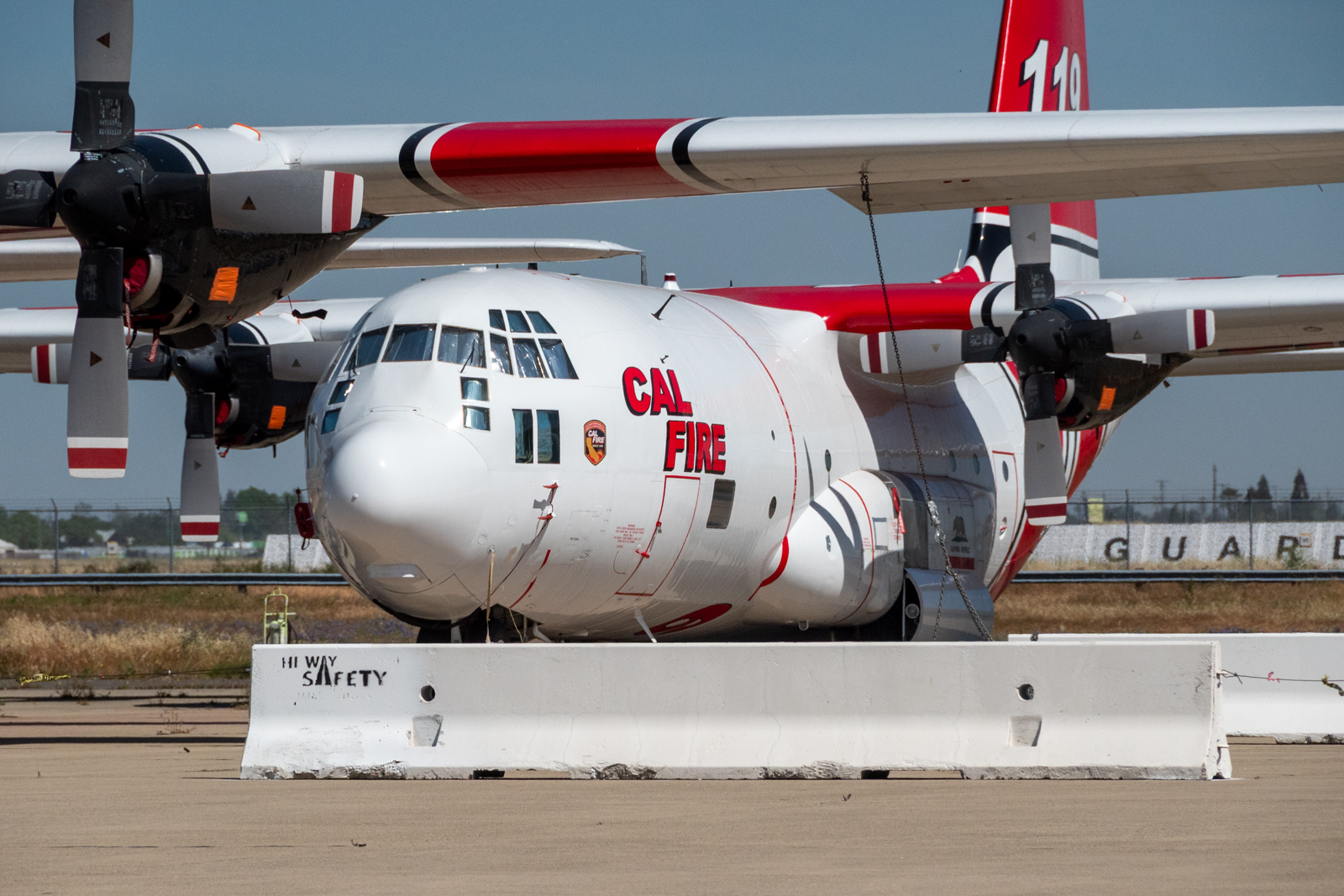
CalFire Chief Joe Tyler highlighted the agency’s growing aerial fire fighting capabilities at a May 5 press conference held at the CalFire’s McClellan Airport (MCC) headquarters.
Tyler said the agency is expanding the aviation program, with seven C-130s going into service. While the agency does not have an exact timeline, Tyler said the second C-130 went into service on April 24 and was moved to the Fresno Air Attack base on Monday. In a followup email to Wingman, CAL FIRE spokesman Jessee Torres estimated that the remaining aircraft will be in service over the next year.

One of the most recent C-130 acquisitions is a former NASA aircraft, according to aviation historian and photographer Roger Cain.
CalFire’s lead C-130 instructor pilot Brian Baker told Wingman the aircraft’s capabilities make it an excellent platform for fire fighting. The agency’s C-130s have been fitted with a 4,000 gallon tank that holds 36,000 pounds of retardant, Baker said. Although the aircraft could hold more, Baker said the configuration is a balance between capacity and performance.
“This is about all the C-130 can carry while still giving us the performance margin to go out and be able to maneuver in the foothills in order to get the retardant where it needs to go,” Baker said.

Tyler said the agency is also working to replace the last two legacy UH-1 helicopters with the Firehawk by the end of May. The UH-1, better known as the Huey, was originally developed as a transport helicopter during the Vietnam War.
In an interview with Wingman during the event, Firehawk Pilot Jason Thrasher said the agency trains more than 40 pilots at McClellan each year. Some of that training is to keep existing pilots current as well as getting new pilots up to speed. Much of those training flights in the Sacramento area happen from November through May when the wildfire risk is lower, he said.
In addition to pilot training, CalFire sorties from McClellan can involve maintenance check flights and ferry flights, Thrasher said.
Thrasher encouraged general aviation pilots to report potential wildfires, but cautioned against flying closer to investigate them.
“If you see a fire, you see smoke, and you’re in general aviation,and you think you want to go investigate it, I would say don’t,” Thrasher said, adding that general aviation aircraft should allow at least 10 miles to avoid incoming CalFire aircraft. “Don’t go investigate that fire, somebody’s going to be on it.”
He also encouraged all aviators to check for any Temporary Flight Restrictions (TFR) before takeoff, although some smaller incidents could be under Fire Traffic Area (FTA) protocol rather than a TFR.
Thrasher has not had any incidents with general aviation aircraft in his 18 years of flying with CalFire, saying “general aviation is really good here.”
CalFire’s headquarters at McClellan also supports pilots through flight simulators. The agency runs two S-70i Firehawk simulators and one C-130 simulator.

The agency has more than 60 aircraft among 14 tanker bases, 10 CAL FIRE helitack bases, and one joint base with the San Diego County Sheriff, according to their website.
Officials from several California agencies were on hand during the event, including the California Highway Patrol, California State Parks, and the Office of Emergency Services. Agency leaders stressed the importance of wildfire prevention ahead of what officials are predicting to be a hot and dry summer fire season.


Leave a Reply