
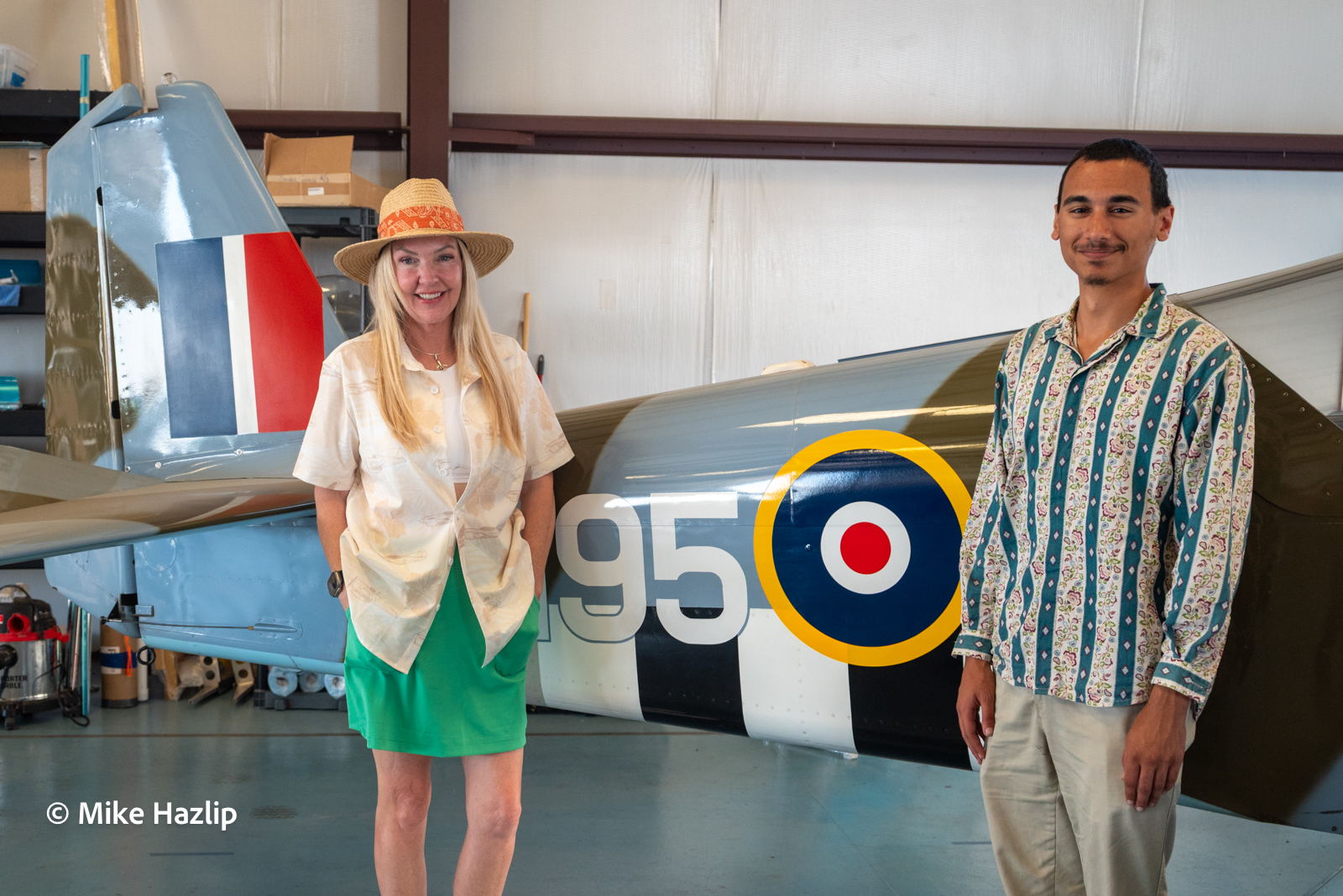
Mary Wick and Hayden Meads stand with Spitfire Aviation’s RV-6A painted in WWII British Spitfire livery.
Aspiring aviators near Lincoln Airport (LNK) have a more affordable option to start their pilot training, thanks to a free ground school offered through Spitfire Aviation.
Pilot and instructor Mary Wick said she has been teaching students at other airports since 2010. Wick said she started offering flight training at Lincoln Airport when opportunities to work in commercial charter flights brought her to the Sacramento area in 2016.
Initially charging for ground school, Wick said pandemic shutdowns forced students to attend remotely and she stopped charging for the online classes. Now she says it’s a way to give back to the community, and plans to continue the free ground school.
The last class of Spitfire Aviation graduated earlier this year, and the next ground school class is set to start in September, Wick said.
With over 20 years flying and about 4,500 hours, Wick is also a member of the Ninety-Nines, an organization dedicated to supporting women in aviation. She says the ground school is needed to help others achieve their dreams.
“There are really good people that need opportunities,” Wick said. “And there are people who don’t get those opportunities. They’re not able to take advantage of them so they’re not able to pursue their dreams.”
Not all of the students who start the class see it through to the end, Wick said, but so far, 100 percent of those who finish have passed their FAA written exam. Students also build community together, according to Wick, with some students forming a partnership to purchase an aircraft they share together in what the FAA calls fractional ownership.
“They become a cohesive unit,” Wick said of the volunteers, instructors, and students. “This is the first aviation family for many of these people. It’s the first time they’ve been at a small airport.”
Part of that small airport experience is attending classes in a hangar at Lincoln Airport. In addition to the challenging coursework, the accommodations inside the hangar can be subject to weather extremes, Wick said. Although Spitfire Aviation provides a heater in the winter and fans in the summer, the ground school is not the typical classroom experience.
“For some people, it’s the first time in their life that they’ve been really uncomfortable yet continued because they want something,” she said. “So it’s these personal battles and these achievements.”
Although Wick is not as involved in the day-to-day flying lessons, she said she relies on volunteer instructors and guest speakers to give students a well-rounded education.
“I’m just a very small part of this amazing Spitfire community,” she said. “In the last ground school, we had 11 instructors, 10 speakers, and a dozen volunteers!”
One of the challenges for Spitfire Aviation has been finding Certified Flight Instructors, known in the industry as CFIs, who have the right mix of a focus on mentoring good students with an adherence to regulations, she said.
Wick said she is seeing a cycle with some less experienced instructors using their position as a stepping stone in their career path and passing on what she called “bad habits” to students. These students then become instructors on their way to the airlines, and the pattern repeats. It’s an issue that she calls a “disconnect” between instructor and student.
“A lot of these CFIs don’t necessarily want to be instructors, they want to get to the airlines,” Wick said. “So they’re building the time and they’re getting paid to build the time, so it’s tough to find people that really care in that world.”
The school shut down for about six months due to a lack of qualified instructors. Now, Wick said she has three instructors at Lincoln and one at McClellan (MCC).

One of the ground instructors at Lincoln Airport is 20-year-old Hayden Meads who was a student himself. Meads started the program a few years ago and is now helping coordinate other instructors and guest speakers. He is currently teaching ground school at Spitfire Aviation with an eye on becoming a CFI. He said Wick has helped him launch his aviation career through an internship that helped offset the costs of flight training.
“I had been working at a fast food restaurant but the pay wasn’t very good,” Meads said. “At that time, I didn’t have a car so I would ride the bus to the airport and she helped me quite a lot. She saved me a lot of money and I got a lot of good experience in training.”
What makes the Spitfire Aviation flight school unique is that the funding comes from Wick’s other aviation pursuits and donations rather than directly from student tuition, she said.
“The flight school isn’t paying our bills,” she said. “I think that’s the real difference of what’s going on with Spitfire. We’re paying our bills through other means of aviation and it’s our way of giving back. And it’s a blast.”
One of those alternative income streams was the Spitfire Cafe, a restaurant at the Lincoln Airport, Wick said. Flight school students could work at the restaurant to help offset the cost of aircraft rental and instructor time. She shuttered the cafe at the end of 2024 after her commercial flying career became more demanding of her time and there wasn’t enough capital for a full-time manager, she said.
For Wick, seeing students achieve their dream of flight is the most rewarding part of Spitfire Aviation.
“When people know that you really care, they invest too, when you invest in them, they invest in themselves, and a lot of people, they just really need someone to care about them,” an emotional Wick said. “Then they invest in themselves because sometimes they need to be told they’re worth it, and then they just blossom.”


Leave a Reply